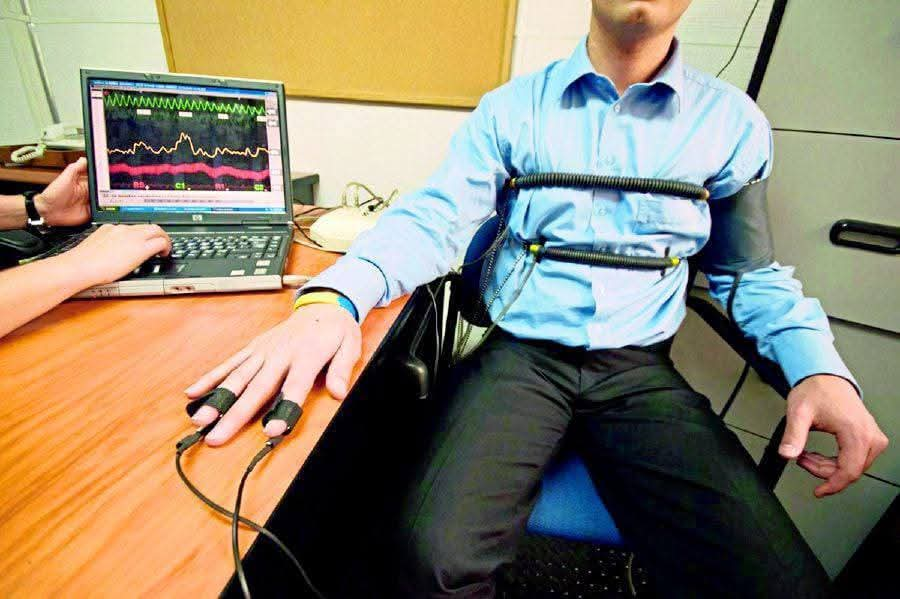
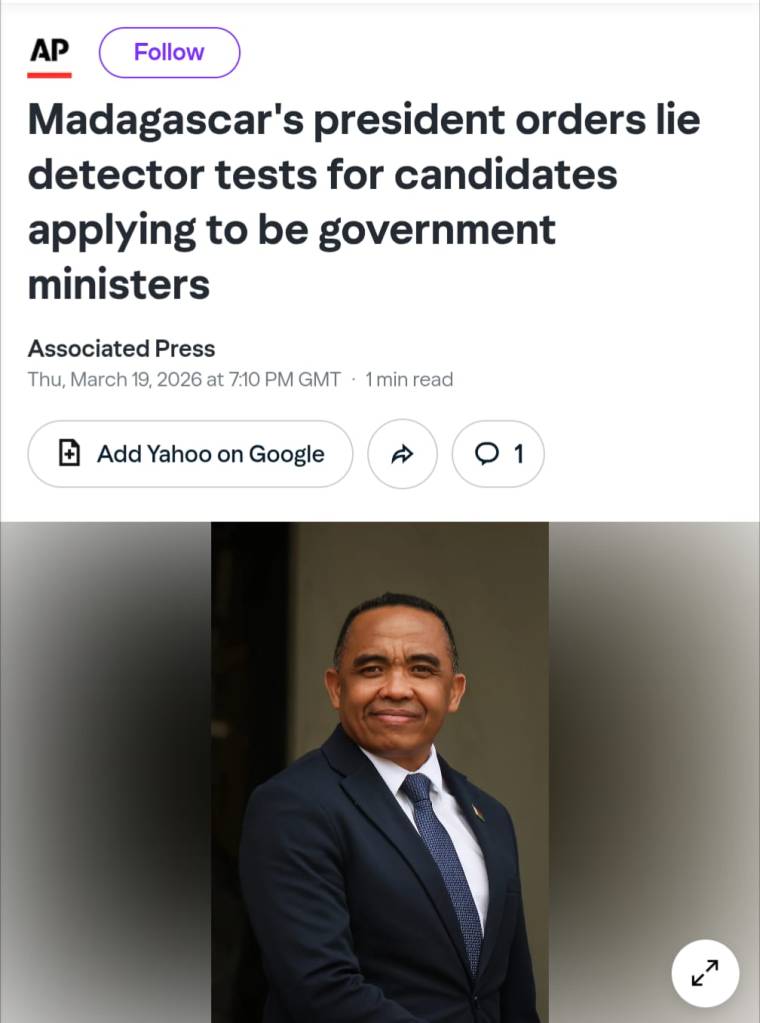
Madagascar’s new head of state, President Michael Randrianirina, announced this week that anyone seeking a ministerial position in his government will first be required to pass a polygraph test. “We will know who is corrupt and who can help us,” he declared. Yahoo!
The news has stirred conversation across the country. But beyond the political debate, this decision raises a profound spiritual question that every believer ought to sit with: What does it say about our society when a machine is needed to tell us what a person’s character should make plain?
Integrity: When Two Lives Become One Secret
A lie detector becomes necessary when people have learned to present one face to the world while hiding another entirely. We have all seen it — the respectable figure whose private life is a contradiction of everything he publicly represents. The Bible has a word for this: it is called duplicity, and God hates it.
Proverbs 11:3 declares, “The integrity of the upright will lead them, but the crookedness of the treacherous will destroy them.”
Integrity, in its root meaning, speaks of wholeness — being the same person in every room, before every witness, under every pressure.
A person of integrity does not need a polygraph because their private life is simply a continuation of their public one. There are no secrets to uncover, no hidden compartments in the soul.
When leaders require machines to verify what should be evident to all, it is a symptom of a deeper crisis — a generation of public servants who have mastered the art of disguise. They wear virtue like a costume, removing it when no one is looking. The tragedy is not merely political. It is deeply human.
However, God is not fooled; He warned through the prophet Samuel: “…for God sees not as man sees, for man looks at the outward appearance, but Yahweh looks at the heart.” (1 Samuel 16:7b).
Transparency: When Hiding Becomes a Lifestyle
The lie detector is also a response to a culture of concealment. Candidates lie about their qualifications. They misrepresent their past. They disguise their true intentions behind polished speeches and noble-sounding promises. Transparency — the willingness to be known as one truly is — has become a rare and precious commodity in public life.
The Word of God calls us to something radically different. “Therefore, laying aside falsehood, speak truth each one of you with his neighbor…” (Ephesians 4:25a). The Apostle Paul understood that a community — whether a church or a nation — cannot be built on deception. When leaders conceal who they are, the people they serve pay the price.
Jesus himself was unmistakably clear on this matter: “But let your statement be, ‘Yes, yes’ or ‘No, no’; anything beyond these is of the evil one.” (Matthew 5:37). Our Lord was calling his followers to a life so thoroughly honest that elaborate verification systems would be entirely unnecessary. A person who walks in the light has nothing to hide and nothing to fear from scrutiny.
Morality: When Sin in High Places Becomes the Norm
Perhaps the most sobering dimension of this story is what it reveals about the moral landscape of leadership. President Randrianirina himself acknowledged the depth of the problem, saying he was not looking for someone “100% clean” but rather someone “more than 60% clean.” South China Morning Post
That a standard of 60% moral cleanliness is considered aspirational for government leaders tells us sadly how far things have fallen.
Immoral leaders are not a new problem. The Bible is remarkably honest about the damage they cause. “When the righteous increase, the people are glad, but when a wicked man rules, people groan.” (Proverbs 29:2). A nation groans under leaders who use power to serve themselves, whose hidden sins eventually surface as public scandals, whose corruption trickles down to impoverish the very people they were meant to serve.
The polygraph machine is, in essence, a cry of desperation — a society’s admission that it can no longer trust the moral professions of those seeking to govern it. When Micah 6:8 calls leaders to “do justice, love kindness, and walk humbly with your God,” it is describing a character visible in conduct, love and justice in words and deeds; not a virtue detectable only by a machine.
A Challenge for Every Believer: Pass Your Own Test
Instead of pointing further on politicians and public figures’ shortcomings, God’s Word turns the mirror toward us.
As followers of Christ, we are called to be the living proof that integrity, transparency, and morality are not impossible ideals — they are the natural fruit of a life surrendered to the Holy Spirit.
“You are the light of the world. A city set on a hill cannot be hidden” (Matthew 5:14). Our testimony is not merely what we say in church on Sunday. It is the full, unedited story of our daily lives — how we handle money, how we speak when we think no one is listening, how we treat people who can do nothing for us.
The question worth asking ourselves is this: if a polygraph were placed before us today, would our public confessions match the private reality of our hearts?
The world is weary of leaders — and of people — who say one thing and live another. What the nation, any nation, needs is not simply better technology to unmask hypocrisy. It needs men and women whose lives are an open book, whose yes means yes, and whose godliness is not a performance but a genuine and daily walk with the living God.
“Let your light shine before men in such a way that they may see your good works, and glorify your Father who is in heaven.” (Matthew 5:16)
May that be the testimony of every one of us who believe and have surrendered our life to Christ — not because we passed a test, but because we walk Coram Deo, in the presence of God.

 Madagascar 3M