

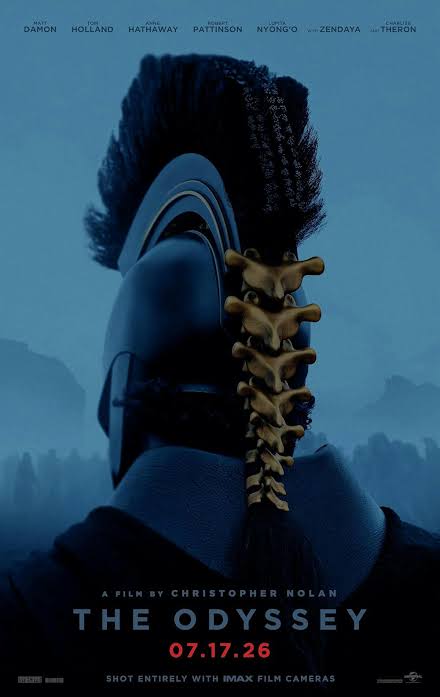
I walked out of the theater still turning the film over in my mind. Christopher Nolan’s The Odyssey is, on the level of craft, a masterclass. Hoyte van Hoytema’s cinematography, Ludwig Göransson’s score, the sheer scale of it shot for IMAX, the very “raw” approach to the fight scenes. Matt Damon’s Odysseus is a man stretched thin between duty and despair, and the film never lets you forget it. As pure filmmaking, it is EPIC in every sense of the word, and I enjoyed it thoroughly.
But what stayed with me longest wasn’t the spectacle. It was how much of the story pressed on questions the human heart cannot stop asking.
Ancient Myth, Timeless Ache
The Odyssey is Greek mythology, gods squabbling on Olympus, monsters guarding straits, a hero trying to find his way home. And yet underneath the fantastical machinery, Homer’s tale (and Nolan’s telling of it) keeps circling back to things every one of us wrestles with:
– Life and death. Odysseus descends among the shades, sees comrades lost to war and sea, and returns changed. He is a man who has looked at mortality and cannot unsee it.
– Guilt and its weight. Every choice on that voyage costs someone something. Men die because of decisions made in pride, in fear, in weakness. The film doesn’t let its hero off easy; his guilt travels with him the way ours does.
– Atonement. Odysseus spends the whole story trying to earn his way home, through suffering, cunning, penance to offended gods. Homecoming has to be paid for.
These themes resonate because they are not really Greek. They are human. Every culture, every age, tells some version of this story, because every person alive carries the same three questions: Why must I die? What do I do with my guilt? How could I ever be made right again?
The Limits of a Beautiful Myth
Here is where I want to be honest, as someone who loved the movie and also loves the Gospel: The Odyssey is man asking eternity’s questions and answering them with his own imagination. The gods of Olympus are petty, capricious, bribable; they reflections of human nature projected onto the heavens, not a real answer to sin or death. Atonement in Homer’s world is transactional and never final; Odysseus never really finds peace, only survival. Guilt is managed, not removed. Death is mourned, never conquered.
That is what every myth and fable ultimately is: a magnificently unsuccessful human attempt to answer questions only God can answer. Nolan filmed something beautifully, but aesthetic beauty is not the same as truth.
Scripture doesn’t leave us guessing:
– Why must I die? Because “the wages of sin is death” (Romans 6:23). This is not the whim of a fickle god, but the just verdict of a holy One against real rebellion.
– What do I do with my guilt? I cannot manage it, appease it, or outrun it on a twenty-year voyage. It must be atoned for. And Christ has done it: “In him we have redemption through his blood, the forgiveness of our trespasses” (Ephesians 1:7).
– How could I ever be made right? Not by cunning, not by suffering enough, not by self-inflicted punishment, not by pleasing capricious powers, but by grace, through faith, in the finished work of the cross (Ephesians 2:8–9).
Odysseus rows, schemes, and bleeds his way toward Ithaca and never fully arrives at rest. Jesus Christ says, “Come to me, all who labor and are heavy laden, and I will give you rest” (Matthew 11:28). And He means it, because He is the one who already bore the wrath, already descended into death, and already rose again to prove the debt is paid.
An Invitation
If the film moved you, if watching a man wrestle with death, guilt, and the ache for home stirred something true in you, don’t stop at the myth. That ache is not an accident. God has “put eternity into man’s heart” (Ecclesiastes 3:11) so that we would look past every fable and every god of our own making, and seek the true and living God who has actually spoken, actually acted, and actually saved.
You don’t need twenty years at sea to find your way home.
Turn to Jesus Christ today. He is the way, the truth, and the life (John 14:6), the only Redeemer who has already made the journey for you, through death and out the other side, so that you could be welcomed home for good. An eternity in His presence.
“Behold, now is the favorable time; behold, now is the day of salvation.” (2 Corinthians 6:2)

 Madagascar 3M